

Data pipelines are the backbone of modern, data-driven enterprises. They enable the flow of data from an ever-growing number of sources, transforming it to make it suitable for analysis. But errors can occur as your data moves from one system to another, so monitoring them is crucial.
If you’re looking for 10 best data pipeline monitoring tools, this list breaks down options across ETL/ELT platforms, data observability suites, and broader cloud monitoring tools, so you can pick the right fit for your stack and team.
Here are five key things to know about data pipeline monitoring tools:
- Data pipeline monitoring tools ensure data quality and operational efficiency.
- The periodic review and monitoring of data pipelines can help ensure they remain compatible with new data types and formats.
- Data pipeline monitoring tools also provide valuable insights into your data pipelines, enhancing business intelligence.
- There are many data pipeline monitoring tools available, including Integrate.io, Fivetran, Stitch, and more.
- The best pipeline monitoring tools offer integrations with your tech stack, features such as data flow tracking, and the ability to scale with your business.
In this guide, we’ll cover ten of the best data pipeline monitoring tools that can help you manage the performance and health of your data pipelines.
What Are Data Pipeline Monitoring Tools?
Data pipeline monitoring tools are platforms designed to oversee the performance and health of data pipelines.
These tools are essential in maintaining data quality and reliability by continuously tracking data flow, identifying potential bottlenecks, and alerting users to anomalies or errors during data processing.
Most data pipeline tools have an integrated data monitoring component with varying degrees of complexity.
How to Evaluate Data Pipeline Monitoring Tools
Selecting the right data pipeline monitoring tool is crucial for maintaining the health and efficiency of your data operations. Here are the key factors to consider when evaluating data pipeline monitoring tools.
Compatibility and Integration
The data pipeline monitoring tool you choose must be compatible with your existing data pipeline infrastructure and easily integrate with the data sources and storage systems you use. It must also be capable of handling different data formats.
Features and Functionality
Look for tools that provide comprehensive monitoring capabilities, such as real-time data flow tracking, performance metrics, anomaly detection, and error logging.
A user-friendly interface and robust visualization capabilities are also crucial for helping users understand and interpret the data pipeline's performance and health at a glance.
Scalability and Performance
What to look for in a Data Pipeline Monitoring Tool
Choosing a monitoring tool that can scale with your data operations is vital. Assess the tool's ability to handle increasing data volumes, pipeline complexity, and the number of users without compromising performance or accuracy.
Many teams start this search by asking for ETL software with automated pipeline monitoring, meaning the same platform that moves and transforms data also tracks job status, failures, latency, and SLA risk without requiring separate add-ons. Look for:
-
Pipeline-level dashboards (runs, failures, latency, throughput)
-
Configurable alerts (Slack/email/webhooks) routed to the right owner
-
Retry + failure context (clear error logs and remediation steps)
-
Visibility into transformation errors (not just ingestion uptime)
In this category, platforms like Integrate.io stand out because monitoring is built into the workflow (pipelines + jobs + alerts) and supports both ETL and ELT, which matters as teams mix warehouse-first and transformation-first patterns.
Which are the Best Monitoring Tools for Scalable Data Pipelines in the Cloud?
Integrate.io, Fivetran, and Hevo Data are among the best monitoring tools for scalable cloud data pipelines. Integrate.io provides built-in monitoring with pipeline-level dashboards, job status tracking, error alerts, and SLA management, ensuring real-time visibility into data flows without third-party add-ons. These options are especially relevant if you want a cloud service that combines scalable data integration, transformation, and built-in monitoring in one place.
1. Integrate.io
Rating: 4.3/5 (G2)
Key Features:
- Data monitoring: Comprehensive monitoring capabilities provide real-time visibility into data pipeline performance and health.
- Data alerts: Customizable alerts keep you informed about critical events and issues for proactive issue resolution.
- Hundreds of pre-built connectors: Simplify integration with various data sources and destinations for seamless data movement.
- ETL and ELT: Supports Extract, Transform, Load (ETL) and Extract, Load, Transform (ELT) processes for flexible data integration and transformation.
- CDC: Change Data Capture (CDC) functionality enables efficient tracking and synchronization of data changes from source to target systems.
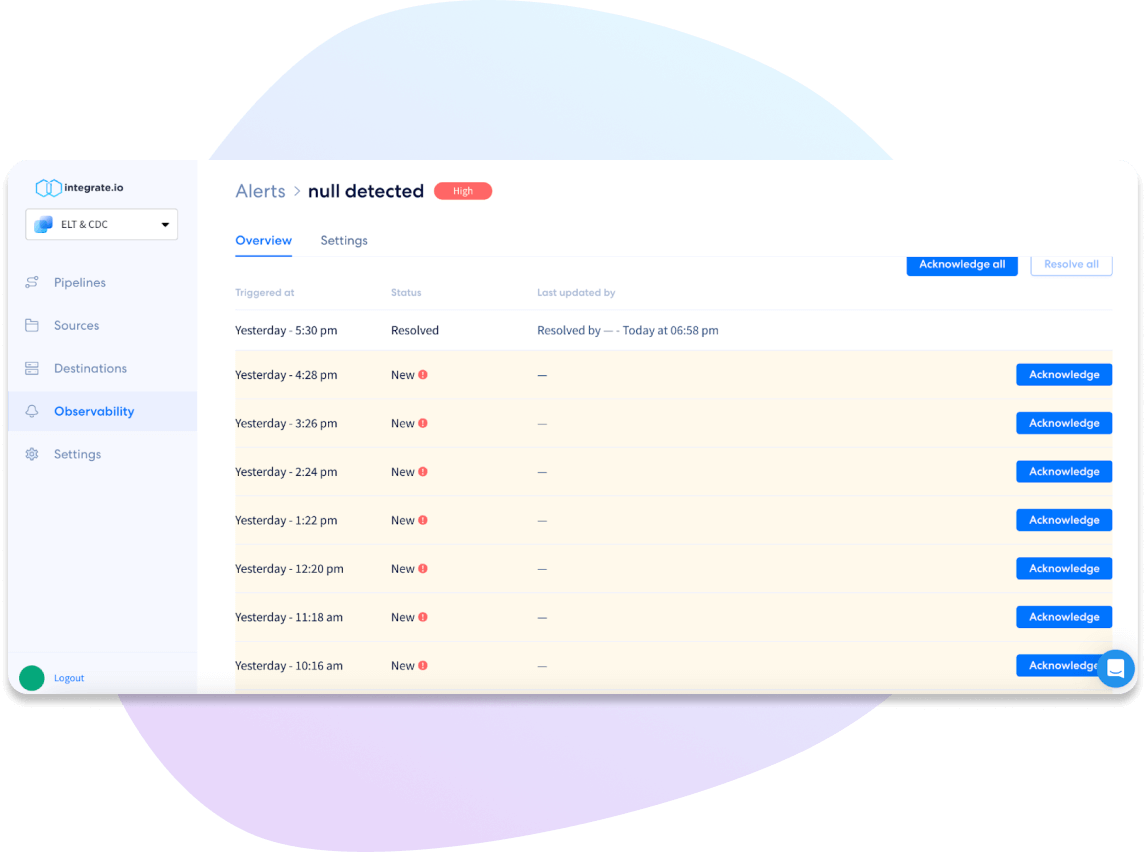
Integrate.io is an excellent choice when looking for the best monitoring tools for scalable data pipelines in the cloud. It is a powerful, no-code/low-code data integration and monitoring platform with comprehensive data pipeline management capabilities. Its data observability feature provides real-time visibility into your data pipeline's performance and health, allowing you to identify and address issues quickly.
For teams evaluating cloud ETL/ELT + data transformation together, Integrate.io’s built-in monitoring helps you catch pipeline and transformation issues early through dashboards, job status tracking, and alerting, without relying on third-party monitoring add-ons.
The platform's support for both ETL and ELT processes allows for flexible data integration and transformation. At the same time, its CDC functionality ensures that target systems are always up-to-date with the latest data changes.
One of Integrate.io’s key differentiators is that even non-technical users can quickly create a complex data pipeline in minutes due to its no-code/low-code capabilities and hundreds of pre-built data connectors.
Pros
-
Low-code, fixed-fee ETL/ELT platform
-
Unlimited pipelines, connectors, and data volume at defined pricing
Cons
- Pricing may not be suitable for SMBs which are entry level
Pricing
-
Fixed fee, unlimited usage pricing model

2. Fivetran
Rating: 4.2/5 (G2)
Key Features:
- Automated data governance: Ensures teams have the visibility and control to manage their data assets effectively.
- Data lineage graph: Monitor data movement, logs, and statuses from extraction to warehouse load.
- Centralized alerts and notifications: Manage connector and transformation alerts in Fivetran for simplified troubleshooting.
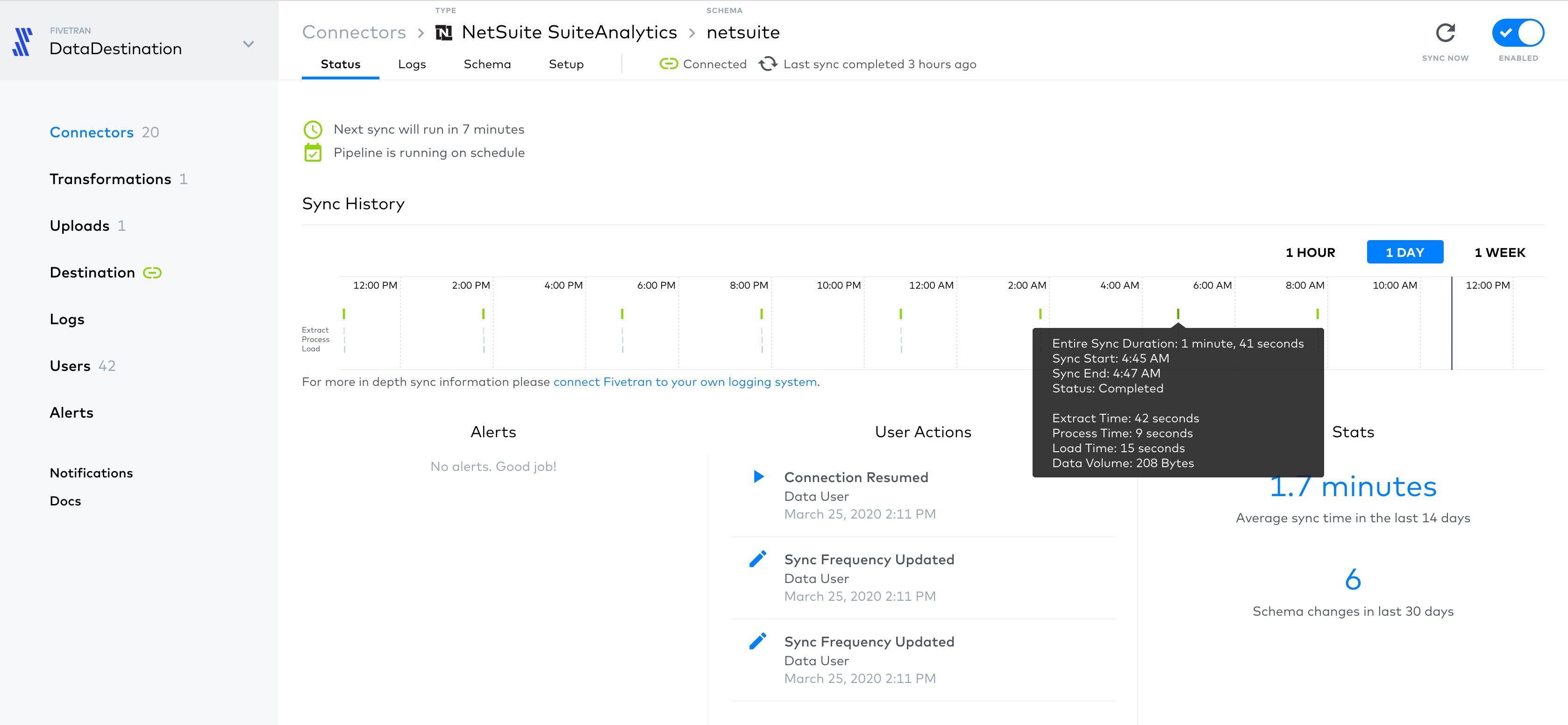
Fivetran is a powerful data integration platform with data movement and management capabilities. Its data lineage graph allows users to monitor data movement and status throughout the pipeline, providing full visibility and control.
At the same time, integrated scheduling and centralized alerts and notifications streamline orchestration and troubleshooting for a seamless user experience.
Pros
-
Fully managed ELT with automated schema evolution
-
Wide connector library and scalable pipelines
Cons
-
Consumption-based pricing can be unpredictable
-
Limited transformation control before loading
Pricing
-
Free tier up to 500k monthly active rows (MAR)
-
Usage-based pricing beyond that

3. Hevo
Rating: 4.3/5 (G2)
Key Features:
- Intuitive dashboards: Monitor pipeline health, failures, and real-time data flow for improved visibility and control.
- Automated pipelines: Easily set up and maintain pipelines for 150+ data sources without manual intervention.
- Preload transformations: Format data on the fly and override auto schema mapping for precise control over data loading.
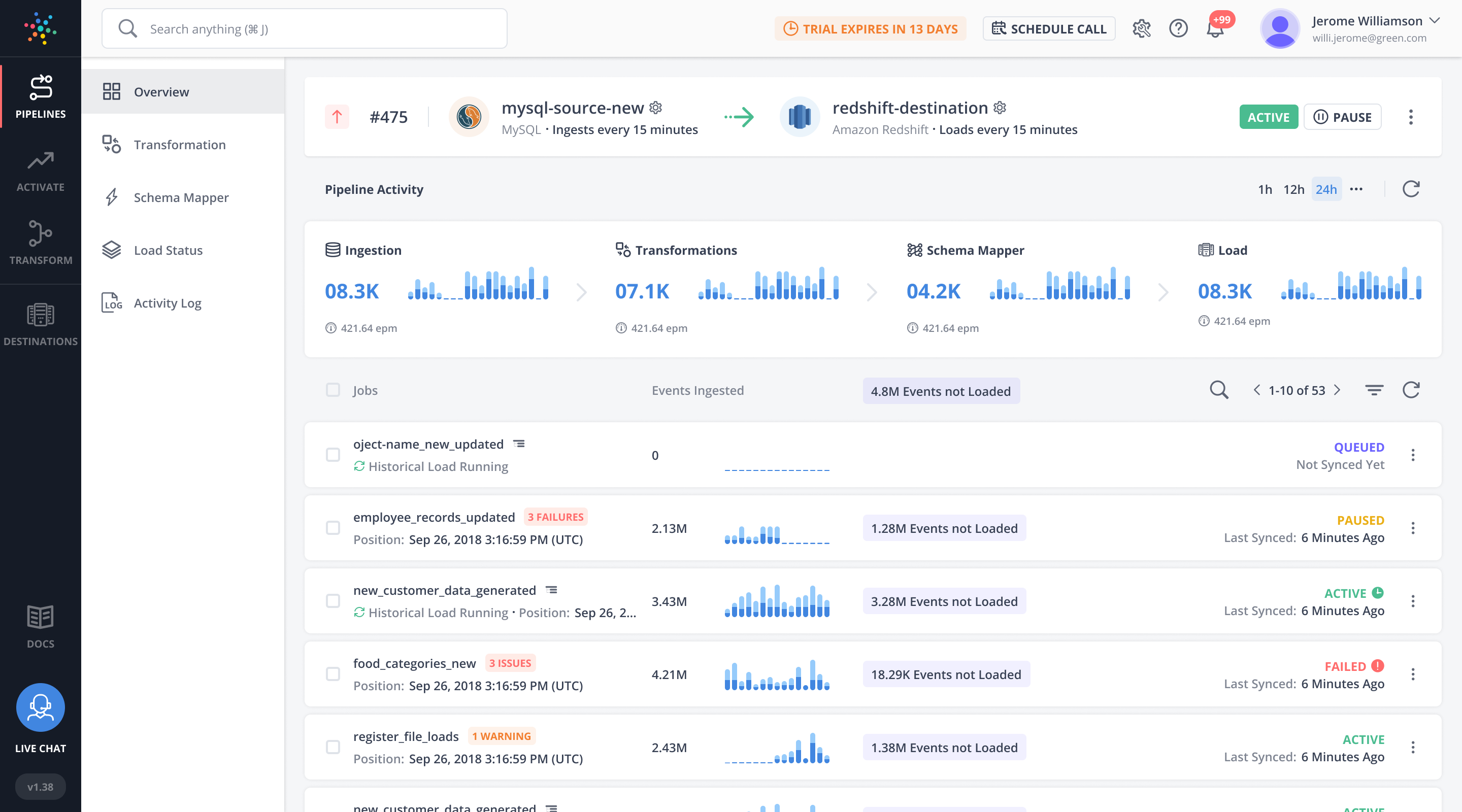
Hevo is a versatile data integration platform that simplifies setting up and maintaining end-to-end data pipelines. Its intuitive dashboards provide complete visibility into pipeline health, offering total control over your pipelines.
Moreover, the platform’s fault-tolerant architecture ensures high reliability, zero data loss, low latency, and end-to-end encryption for maximum security.
Pros
-
No-code ETL with built-in transformations
-
Transparent event-based billing and good connector support
Cons
-
Smaller connector set than Fivetran
-
Custom connector development not supported
Pricing
-
Free tier: 1M events
-
Starter: $499/month, Business: $999/month, plus enterprise

4. Stitch (by Talend)
Rating: 4.5/5 (G2)
Key Features:
- Data quality: Profile, cleanse, and mask your data while monitoring data quality over time.
- Low maintenance pipelines: Stitch pipelines update automatically and continuously, reducing the need for ongoing maintenance.
- 140+ built-in connectors: Connect to various data sources without writing code.
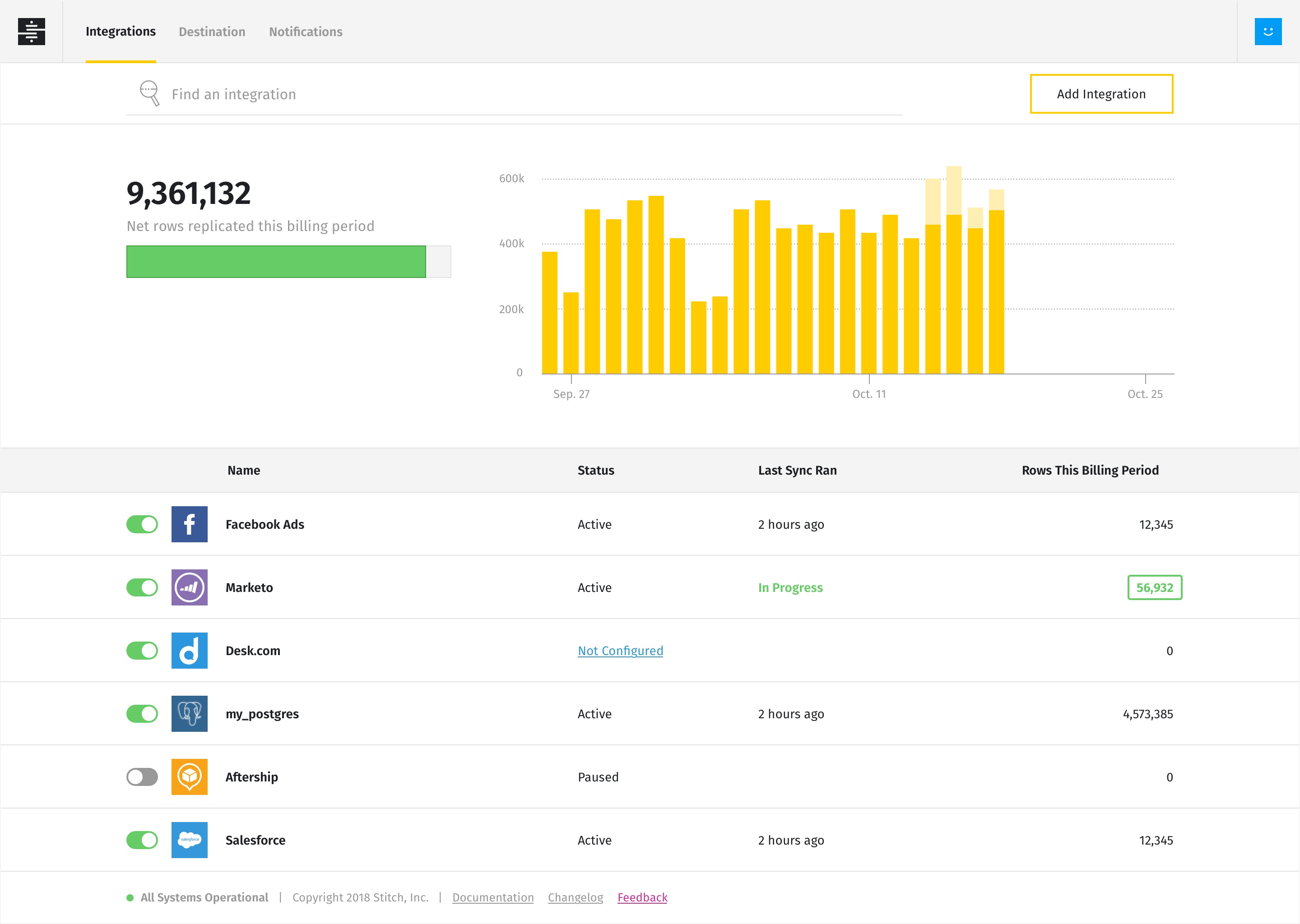
Stitch is a powerful data integration platform that saves engineering time, enabling users to extract data from 140+ popular sources without coding. The platform works alongside other Talend solutions to ensure data quality across all integrations allowing users to profile, cleanse, and mask data regardless of format or size.
With Talend, Stitch also offers additional features such as parsing technology for unstructured data, data masking, and customizable dictionaries for auto-discovering data.
Pros
-
Lightweight ELT, easy for small teams
-
Predictable volume-based tiers, open-source connector support via Singer
Cons
-
Minimal in-pipeline transformations
-
Free tier limited to 5 million rows/month
Pricing
-
Free up to 5M rows/month
-
Standard tier: ~$100–$1,250/month depending on volume

5. Gravity Data
Rating: 5/5 (G2)
Key Features:
- Real-time monitoring: Gain real-time visibility into your data pipelines.
- Automated notifications: Receive status updates via Slack, Teams, and Webhooks.
- Extensive connectors: Gravity Data features over 110 built-in connectors, including APIs, databases, files, and more.

Gravity Data is a data integration platform that simplifies data management. The platform ensures reliable, high-throughput data pipelines from both streaming and historical sources, while its real-time monitoring capabilities provide full visibility into pipeline health.
Pros
-
Affordable, transparent pricing
-
Real-time monitoring, audit trail, unlimited sources/destinations
Cons
-
Pricing often requires direct quote
-
Smaller footprint and visibility compared to larger vendors
Pricing
-
Growth: $299/month (20M rows)
-
Business: $549/month (100M rows); enterprise plans are custom

6. Splunk
Rating: 4.3/5 (G2)
Key Features:
- ML and AI: Leverage machine-level intelligence to predict and prevent issues, improving security and business outcomes.
- Data streaming: Collect, process, and stream data to Splunk and other destinations quickly with real-time processing.
- Powerful dashboards: Create intuitive and informative dashboards to communicate complex data stories.

Splunk is a data analytics platform incorporating machine learning and AI to deliver intelligent insights, improving security and business outcomes. Its real-time data streaming functionality enables it to collect, process, and distribute data within milliseconds.
The platform provides real-time actionable alerts, centralized enterprise controls, and AI-driven analytics, allowing users to confidently scale and troubleshoot across thousands of microservices and billions of events.
Pros
-
Provides deep log management and observability across stack
-
Enterprise scalability for IT and security operations
Cons
-
Typically expensive as data volume grows
-
Requires expertise for optimal setup and tuning
Pricing
-
Highly variable, custom quotes depending on usage and modules

7. Mozart Data
Rating: 4.5/5 (G2)
Key Features:
- Data pipeline observability: Observe your entire data pipeline with clear views of dependencies between tables and transforms.
- Faster troubleshooting: Quickly identify issues in the pipeline with helpful indicators.
- Seamless data integrations: Access and integrate data from various sources, including databases and third-party applications.

Mozart Data is a data management platform that provides clear views of your entire data pipeline, allowing you to observe dependencies between tables and transforms. This allows for faster troubleshooting and helps you identify issues in the pipeline more efficiently.
Pros
-
Intuitive, no-code setup that gets your data stack live in minutes or hours
-
ETL, data warehouse, and SQL-based transformation combined in one platform
-
Excellent customer support and smooth onboarding
-
Easily integrates using Fivetran and offers reliable, centralized data modeling
Cons
-
Billing model lacks upfront clarity, MAR (monthly active rows) becomes visible only during or after trial period
-
Limited connectors for less-common data sources
-
Occasional UI confusion around data entry options (e.g., choosing between Mozart or Fivetran workflows)
-
Minor learning curve when transitioning from tools like MySQL Workbench
Pricing
-
Transparent per-hour analyst support: e.g., +10 hours for ~$2,000, +20 hours for ~$3,500
-
Tiered plans exist (like Sonata, Concerto, Symphony, Opera), starting around $1,000/year, up to $5,000/year for higher usage levels
-
Full custom pricing available, contact sales or request a personalized quote
-
Offers free trial, but no permanent free version

8. Monte Carlo
Rating: 4.7/5 (G2)
Key Features:
- End-to-end coverage: Instantly notify specific data team owners when data incidents occur, facilitating rapid resolution.
- Automated field-level lineage: The platform offers complete and up-to-date field lineage within 24 hours of deployment, enabling full visibility of upstream sources and downstream dependencies.
- Secure and efficient deployments: Monte Carlo is a SOC 2 Type 2 certified platform that monitors data-at-rest, extracting only metadata, query logs, and aggregated statistics for efficient computation.
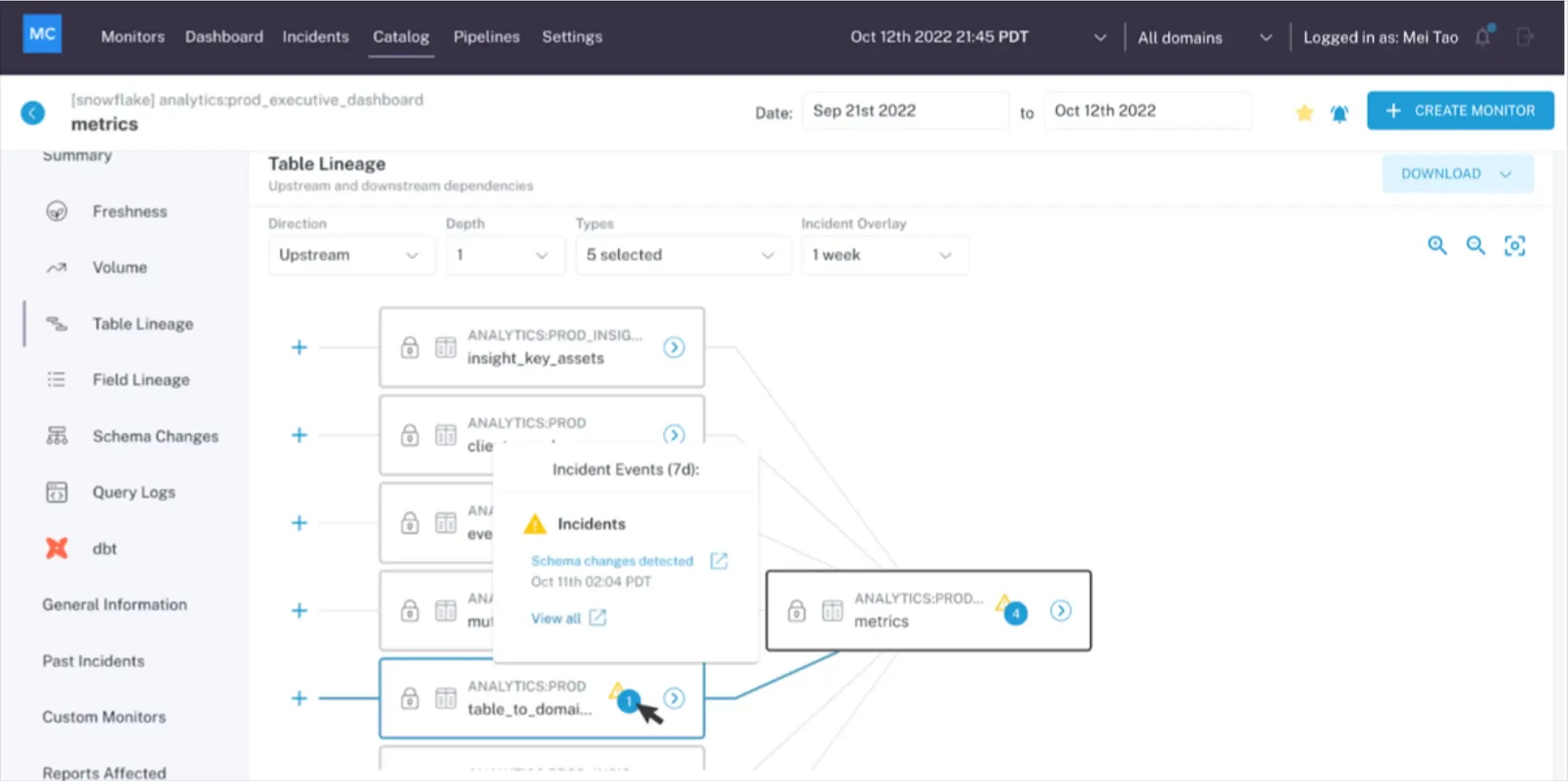
Monte Carlo is a data observability platform providing end-to-end coverage and instant notifications for better data visibility. It fosters efficient root cause analysis across your data stack and is SOC 2 Type 2 certified, ensuring security while monitoring data at rest.
This makes it an efficient solution for businesses that need reliable, automated, and secure data management.
Pros
-
Robust data observability: lineage, anomaly detection, root cause analysis
-
Strong integrations with modern data stack
Cons
-
Can generate high alert volumes if not carefully configured
-
Pricing not standardized, requires tailored quote
Pricing
-
Usage-based: pay per monitor and credits
-
Start, Scale, and Enterprise tiers available

9. Acceldata
Rating: 4.4/5 (G2)
Key Features:
- End-to-end visibility: Provides insights into data assets and pipelines from start to finish for proper data delivery and timeliness.
- Root cause identification: Uses data lineage to trace transformation failures and data inaccuracy across tables and columns.
- Data incident detection and resolution: Applies multi-layer data to identify incidents, isolate problems, and take corrective actions.
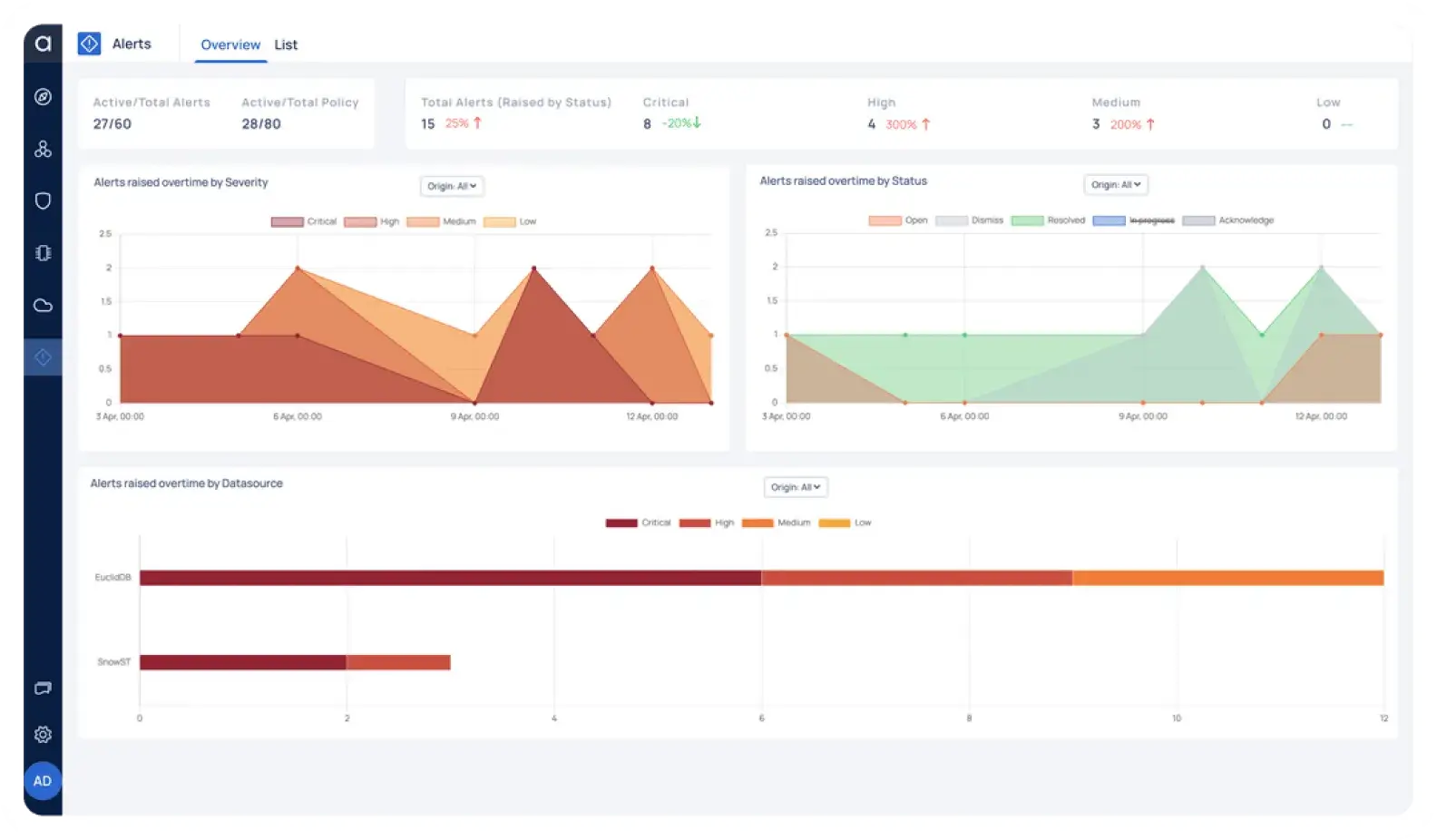
Acceldata is a data observability platform that optimizes data quality and prevents data outages. It offers end-to-end visibility of data assets and pipelines, ensuring proper delivery and timeliness of data.
The platform helps identify the root cause of data issues with data lineage, allowing users to trace transformation failures and data inaccuracies across tables and columns.
Pros
-
Data observability platform for large data ecosystems
-
Focused on monitoring, reliability, and optimization
Cons
-
Pricing and full details not publicly available
-
Relatively newer player compared to Splunk or Datadog
Pricing
-
Enterprise pricing; requires vendor contact

10. Datadog
Rating: 4.3/5 (G2)
Key Features:
- Log data analysis: Allows quick search, filtering, and analysis of logs for troubleshooting and data exploration with automated tagging and correlation.
- Customizable dashboards: Build real-time interactive dashboards that visualize metrics and events from your data pipelines, allowing you to monitor and analyze pipeline performance and health.
- Built-in integration: Datadog integrates with popular data processing platforms, enabling you to monitor your data pipelines more effectively.
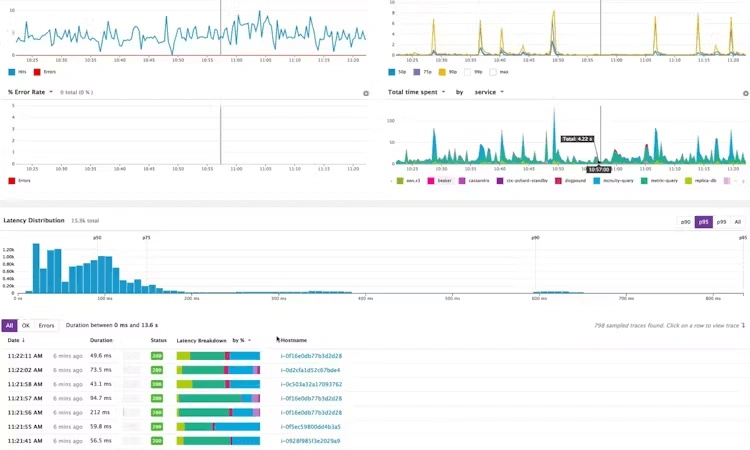
Datadog provides complete visibility into systems, applications, and services. The platform’s data pipeline monitoring features allow you to maintain visibility into the performance and health of your data pipelines, ensuring quick identification and resolution of any issues that may impact data quality.
Pros
-
Unified platform for infrastructure, logs, APM, and AI monitoring
-
Highly extensible, real-time dashboards, strong alerting
Cons
-
Complex, tiered pricing; costly at scale
-
Bills based on high-watermark metrics, making budget planning hard
Pricing
-
Infra Pro: ~$15/host/month
-
APM: ~$31/host/month
-
Additional product-specific rates (logs, security, serverless, etc.)
-
Typical enterprise spend often exceeds $100K/year
Comparison of Best Data Pipeline Monitoring Tools
| Tool | Primary Category | Key Strengths | Deployment | Ease of Use | Integrations | Pricing Model | Best For |
|---|---|---|---|---|---|---|---|
| Integrate.io | ETL / ELT | No-code pipelines, strong transformation, SaaS connectors, API support | Cloud | Easy (drag-and-drop) | 200+ connectors | Fixed fee, unlimited usage based pricing model | Teams wanting low-code ETL + data transformation |
| Fivetran | ELT | Automated schema management, fast connectors, strong replication | Cloud | Very easy (fully managed) | 400+ connectors | Consumption-based (rows/month) | Enterprises needing plug-and-play ELT |
| Hevo Data | ETL / ELT | Real-time pipelines, CDC, 150+ sources | Cloud | No-code | 150+ sources | Subscription (volume-based) | SMBs & mid-market needing real-time ELT |
| Stitch (Talend) | ETL | Affordable, simple setup, limited transformations | Cloud | Easy | ~130 connectors | Tiered pricing (rows/month) | Startups needing low-cost ingestion |
| Gravity Data | ETL (new entrant) | Open-source, affordable, transparent pipeline configs | Cloud & OSS | Dev-friendly | Fewer connectors than Fivetran | Freemium + subscription | Startups/developers wanting OSS ETL |
| Splunk | Observability / Log Analytics | Log ingestion, security monitoring, SIEM | Cloud & On-prem | Complex for non-ops | Wide (logs, events, APIs) | Usage-based (data ingested) | Security, infra & IT monitoring |
| Mozart Data | Modern Data Stack (ETL + Warehouse mgmt) | Combines ETL (via Fivetran/others) + Snowflake + dbt into turnkey stack | Cloud | Easy (all-in-one) | Built on Fivetran/dbt/Snowflake | SaaS subscription | Teams wanting prebuilt modern data stack |
| Monte Carlo | Data Observability | Data quality, lineage, anomaly detection | Cloud | Moderate | Integrates with warehouses, BI tools | Subscription (by data volume/monitored tables) | Data teams monitoring reliability |
| Acceldata | Data Observability | End-to-end reliability + cost monitoring + performance insights | Cloud & Hybrid | Moderate | Broad ecosystem (warehouses, lakes, ETL) | Enterprise subscription | Enterprises needing data reliability + cost control |
| Datadog | Observability (Infra & Apps) | Infra monitoring, APM, logs, security | Cloud SaaS | Moderate (for DevOps) | Cloud platforms, infra, apps | Usage-based (hosts, logs, metrics) | DevOps/SRE monitoring infra & apps |
Simplify Data Pipeline Monitoring With Integrate.io
Integrate.io is a cloud-native data integration platform that simplifies data pipeline monitoring and management. Compared to other solutions, Integrate.io’s low-code/no-code interface allows data teams to efficiently build and monitor data pipelines without extensive technical expertise.
Request a demo today and see how easy it is to create, manage, and monitor data pipelines with Integrate.io.
Data Pipeline Monitoring FAQs
Why is data pipeline monitoring important?
Data pipeline monitoring is the process of tracking and overseeing a data pipeline's operational health and performance. Monitoring can involve ensuring that data is moving through the pipeline correctly and detecting errors or issues that could cause data loss or corruption.
Why Is Data Pipeline Monitoring Important?
Data pipeline monitoring helps identify any inconsistencies, errors, or anomalies in the data, ensuring that only accurate and reliable data reaches the end users or systems. Moreover, regular monitoring can help ensure compliance with data regulations and standards.
What are the metrics for data pipeline monitoring?
Data pipeline monitoring involves key metrics such as latency, traffic, error and success rates, throughput, data freshness, and CPU and memory usage.
Which monitoring solutions offer real-time data pipeline monitoring with error detection features?
-
Integrate.io – Built-in pipeline monitoring that tracks job health, triggers customizable alerts, and immediately surfaces transformation errors in both ETL and ELT workflows.
-
Monte Carlo – AI-powered observability platform designed to detect anomalies like unexpected data volume or schema changes, with proactive alerting.
-
Splunk – Advanced log ingestion and real-time alerting for tracking data pipeline events and detecting anomalies across your stack.
What are the best platforms for end-to-end data pipeline monitoring with strong security features?
-
Integrate.io – Offers full workflows with monitoring, error alerts, and visual clarity throughout the data pipeline process.
-
Datadog – Provides comprehensive observability across infrastructure, logs, application tracing, and pipeline metrics with customizable dashboards and anomaly detection.
-
Dynatrace – AI-driven observability with topology mapping, service tracing, and automated root-cause analysis for data-intensive environments.
Which monitoring tools deliver robust logging and alerting tailored for data pipelines?
-
Apache NiFi – Offers comprehensive audit logging, transformation-level visibility, and anomaly detection via in-pipeline metrics and alerts.
-
Prometheus – Open-source monitoring system that collects real-time metrics, supports flexible queries, and triggers alerts when pipeline performance metrics cross thresholds.
-
Splunk – Enables deep log analytics and alerting, making it easy to audit data workflows and flag abnormal patterns across pipelines .
What’s the best ETL software with automated pipeline monitoring?
Look for ETL software that includes pipeline dashboards, job-level status tracking, configurable alerts, and SLA monitoring out of the box, so you don’t need a separate monitoring product for day-one reliability. Tools like Integrate.io emphasize built-in monitoring (job health + alerts + SLA management) alongside ETL/ELT workflows, which can simplify operations for lean data teams.
What are data transformation tools with real-time monitoring capabilities?
If transformation failures are the main issue, choose tools that surface errors fast and tie them to downstream impact (freshness, broken tables, failed jobs). Integrate.io is a strong pick because it pairs data transformation + ETL/ELT with built-in monitoring (dashboards, job status, alerts). Use ETL/ELT platforms like this for day-to-day reliability; add a dedicated observability tool when you need deeper anomaly detection and lineage across many pipelines.