ETL & Reverse ETL


 ACME SFTP


 Salesforce Production


"Our Salesforce team can now fully automate Salesforce data integration by building pipelines to prep and load data themselves. They don't need IT anymore, and they love it."

Adam Hooper
Head of Central Platforms, DPD UK
Integrate.io is a fixed-fee data pipeline platform for ETL, ELT, CDC and Reverse ETL. Anyone on your team can build pipelines using low-code drag-and-drop or AI agents.
Build it your way. Pick a use case to see it built:
Want to see your pipeline built like this?
Book a DemoTrusted by 1,100+ data and ops teams.








A new source, client file, dashboard, sync, or schema change becomes another ticket, script, handoff, and fragile job to maintain. Ops waits. Engineering loses product time. Leaders get slower onboarding, stale reporting, and less predictable costs as data work grows.
Every pipeline change competes with product work, security work, and the next urgent request.
The people who understand the data still depend on someone else to move, clean, or activate it.
As data volume, client count, and use cases grow, usage-based tools can make pipeline planning harder than it should be.
Your clients send data in different formats, from different systems, on different schedules. Integrate.io helps teams standardize client data from files, APIs, databases, CRMs, apps, and cloud storage into workflows your ops team can run.
Handle recurring client data across files, APIs, apps, databases, and cloud storage.
Define the destination once, map each client into it, and reuse the pattern as the client base grows.
Move day-to-day pipeline work closer to ops while keeping access controls, logs, and audit trails in place.
Fixed-fee pricing keeps pipeline costs easier to plan as data volume, client count, and use cases grow.
Client intake flow
Client sources
Files, APIs, databases
Smart map & transform
Match fields and formats
Canonical schema
Centralized schema management
Destinations
Database, warehouse, files
Every client can arrive differently. We auto map and transform. You keep one repeatable workflow.
Use the same platform for ETL, ELT, CDC, Reverse ETL, file workflows, app integrations, and API-driven pipelines. Start with one urgent workflow, then reuse connectors, transformations, schedules, and monitoring across teams.
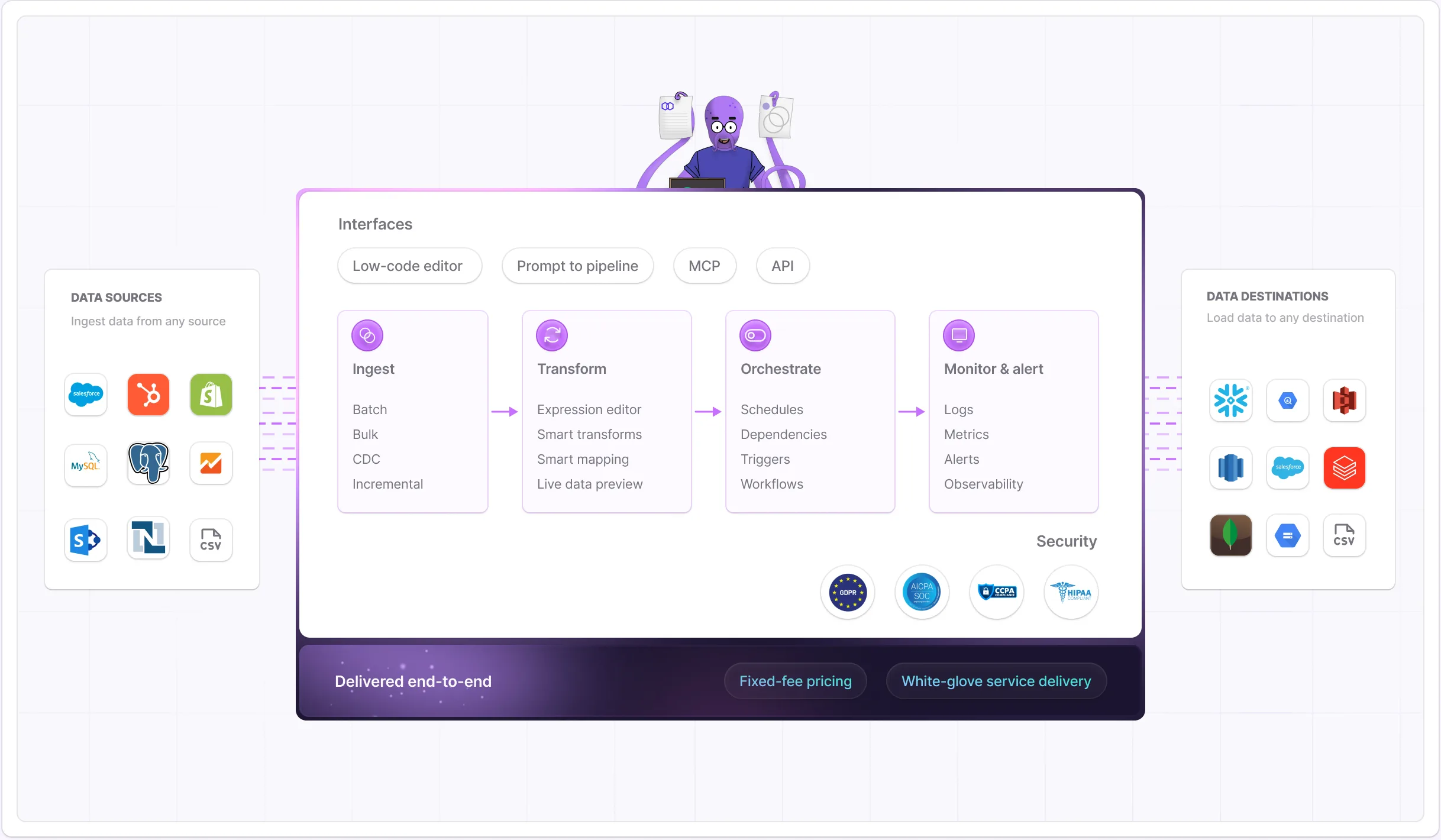
Every method builds the same kind of pipeline, with the same permissions and audit trail. Mix them on one team, or on one pipeline.
Drag and drop sources, destinations and 220+ transformations on a visual canvas.
Learn moreDescribe a pipeline in plain language and Helm builds it. You review and approve before it runs.
Learn moreBuild and validate pipelines from Claude, ChatGPT, Cursor or your own agent.
Learn moreCreate packages, trigger jobs, and manage workflows by API.
Learn moreAnalysts, operators, and engineers can build the pipelines they need, while IT keeps access, standards, and visibility in place.
Predictable pricing for growing data work, without tying budget to every row, sync, connector, or client.
Build visually, prompt with Helm, or add SQL and Python when they help. Teams closest to the data can own the flow.
A dedicated Solution Engineer guides implementation and production work alongside 24/7 support.
Move recurring data work out of the queue and into workflows teams can run.
Use run history, alerts, and logs to spot failed jobs before downstream teams are surprised.
Prepare clean datasets for BI, AI, operations, and the apps teams use every day.
Role-based access, audit trails, SOC 2, HIPAA, and encryption are built in.
You work with real people from the first call through long-term success. The path moves around your goals, data readiness, and launch timeline.
Human support for the first workflow, the next use case, and the production issues that need a fast answer.
2 min
Average First Response
92%
Customer Satisfaction Score
51 min
Average Time to Resolution
Managed sources and destinations, a universal API connector for custom systems, and new connectors built on demand within 24 to 48 hours.
SOC 2, HIPAA, GDPR, SSO, and end-to-end encryption. We never store your data.


“The Integrate.io Platform is a great ETL & Data Transformation Solution! Connecting Salesforce, Hubspot, Google Analytics, Facebook Ads, etc... has never been easier.”

Meir Gold
Growth | Analytics Manager
“Awesome ELT Tool. No code tool, easy to set up/use, nice schedules, price balance!”

Diego Polo
Business Intelligence Architect
“Best Customer Service Ever! They have been the best customer service team I have ever worked with from an outside vendor. Always very responsive, and go above and beyond to resolve issues or instruct on the product.”

Matthew Pratt
Analytics Manager
FAQ
Clear answers to the questions teams ask when evaluating Integrate.io.
Still have questions?
Talk to an expert →Integrate.io helps teams build, run, monitor, and own data pipelines across SaaS apps, databases, files, APIs, warehouses, and operational systems from one managed platform.
Data, RevOps, analytics, Salesforce, engineering, implementation, and customer operations teams use Integrate.io to keep business systems and reporting data current while IT keeps visibility and control.
Client data ingestion is the recurring process of collecting data from customers or partners, standardizing it, mapping it to a target schema, and delivering it to the systems that power your product, reporting, or operations.
Yes. Teams can ingest data, transform it, load it into warehouses, run CDC workflows, and sync trusted data back to operational tools without stitching together separate products.
Integrate.io uses AI to help draft and adjust pipelines with Helm and supported MCP clients. Teams review, edit, and approve the workflow before it runs on Integrate.io with permissions, logs, and audit trails in place.
Many teams can configure a first pipeline during onboarding. Production timing depends on authentication, field mapping, approvals, and the number of systems involved.
Integrate.io includes role-based access, audit trails, alerts, logs, encryption, and SOC 2, HIPAA, and GDPR support for production data workflows.
Integrate.io uses predictable fixed-fee pricing so teams can scale data volume, client count, users, connectors, and use cases without tying budget to every row, sync, or connector.