
"Our Salesforce team can now fully automate Salesforce data integration by building pipelines to prep and load data themselves. They don't need IT anymore, and they love it."

Adam Hooper
Head of Central Platforms, DPD UK
Build, run, and own data pipelines across every source and destination, visually, with AI, or in code. The team closest to the data builds them while IT stays in control, all on a fixed fee.
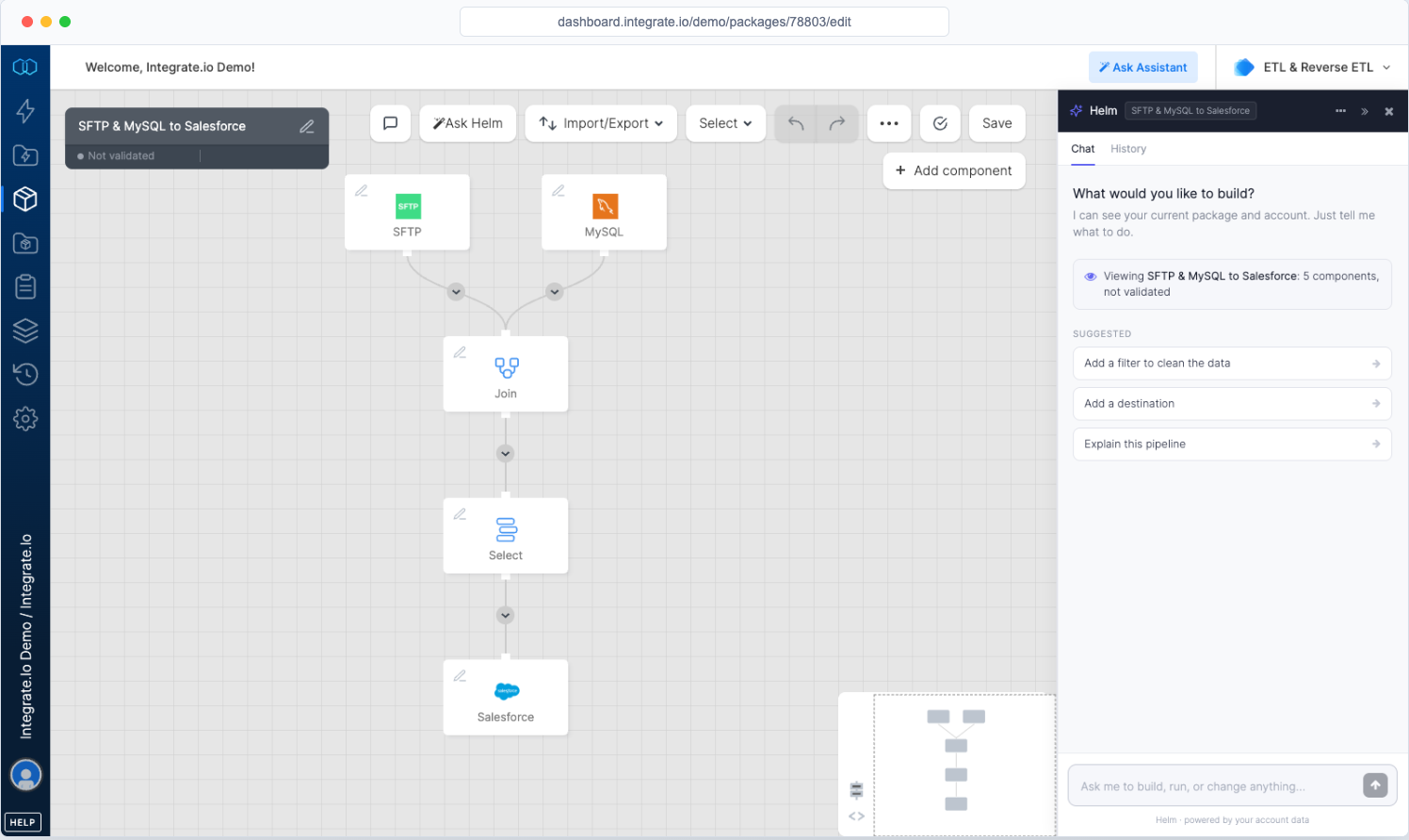
Trusted by 1,100+ data and ops teams saving millions of IT tickets with Integrate.io








Low-code, prompt-built, and AI-assisted.
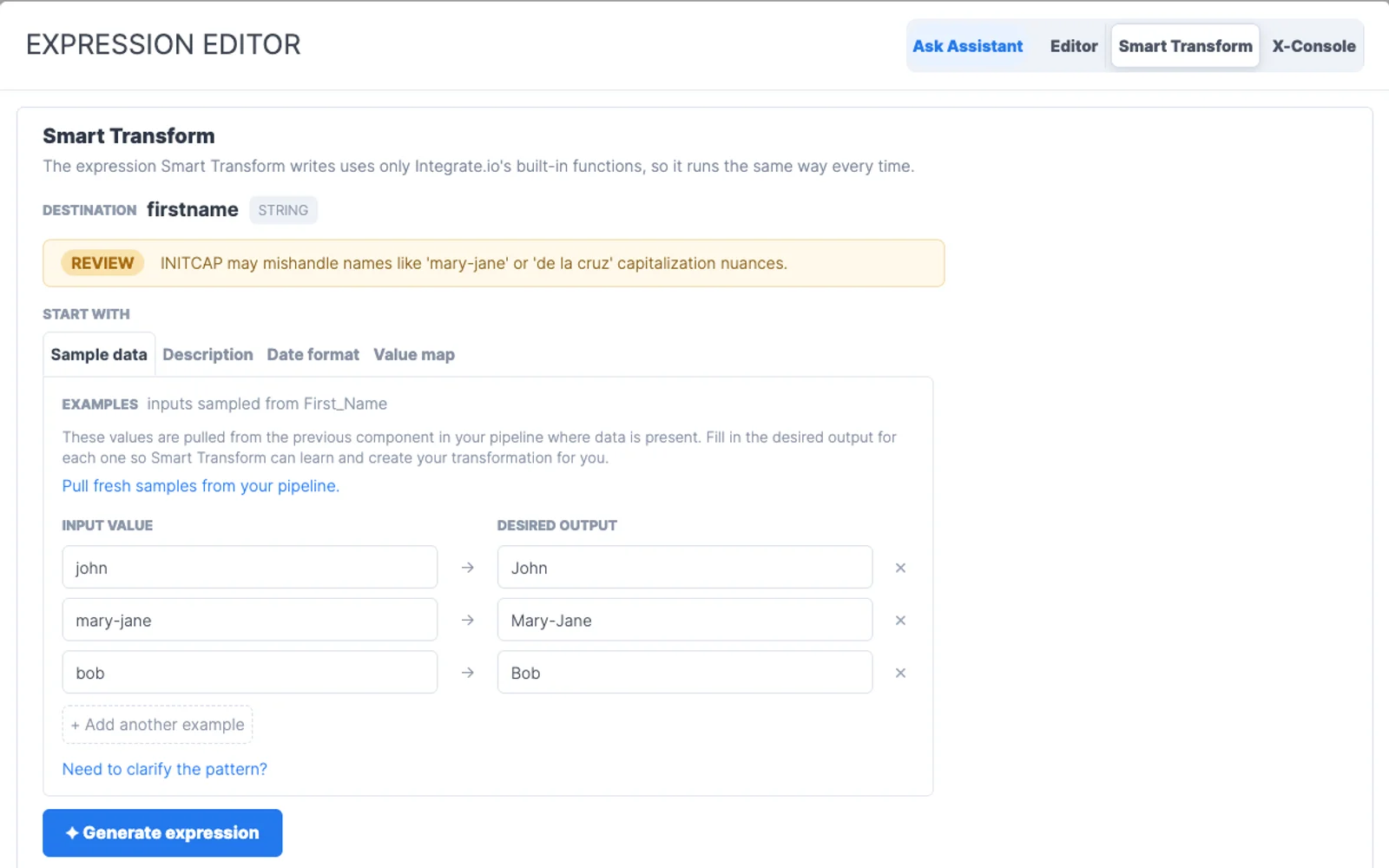

Move data between SaaS apps, databases, files, APIs, and warehouses with managed connectors and a universal REST option.

Clean, join, filter, enrich, and model data before it reaches analytics or operational teams.

Use schedules, alerts, logs, and retry handling to keep production pipelines reliable.

Run every pipeline on one predictable price, instead of costs that climb with rows, tasks, or AI workloads.
See how teams move away from scripts and disconnected tools toward pipelines that are easier to build, watch, and change.
Custom scripts create hidden dependencies that only one or two engineers understand.
Every new source adds connector maintenance, authentication handling, and edge-case code.
Teams discover stale or broken data after reports, syncs, or customer workflows fail.
Separate ETL, ELT, Reverse ETL, and iPaaS tools create handoffs and duplicate logic.
Costs rise with rows, tasks, or sync volume, making pipeline growth hard to forecast.
Visual pipelines make the flow easier to inspect, update, and hand off.
Managed connectors and API options reduce repeated integration work.
Monitoring and alerts help owners spot issues before they spread.
One platform supports ingestion, transformation, loading, activation, and automation.
Fixed-fee pricing keeps scaling decisions simpler.
Analysts, operators, and engineers can build the pipelines they need, while IT keeps access, standards, and visibility in place.
Predictable pricing for growing data work, without tying budget to every row, sync, connector, or client.
Build visually, prompt with Helm, or add SQL and Python when they help. Teams closest to the data can own the flow.
A dedicated Solution Engineer guides implementation and production work alongside 24/7 support.

Use visual components and managed connectors instead of starting every pipeline from code.
Keep transformation logic, schedules, and monitoring visible in one place.

Send data to warehouses, apps, files, APIs, and operational systems.

Give analysts, operators, and engineers a shared way to manage data movement.
Related Workflows
Start with the workflow closest to your use case, then connect it to the rest of your data delivery architecture.
Transform source data before loading it into its destination.
Load source data first, then transform it in the warehouse.
Sync warehouse data back into operational tools.
Standardize customer and partner files into reusable pipelines.
Shape raw data into BI-ready tables for analytics teams.
Keep Salesforce and your other systems in two-way sync.
“The Integrate.io Platform is a great ETL & Data Transformation Solution! Connecting Salesforce, Hubspot, Google Analytics, Facebook Ads, etc... has never been easier.”

Meir Gold
Growth | Analytics Manager
“Awesome ELT Tool. No code tool, easy to set up/use, nice schedules, price balance!”

Diego Polo
Business Intelligence Architect
“Best Customer Service Ever! They have been the best customer service team I have ever worked with from an outside vendor. Always very responsive, and go above and beyond to resolve issues or instruct on the product.”

Matthew Pratt
Analytics Manager
Book a 30-minute demo and watch us deliver your first sync before the call ends.
Talk to an ExpertFAQ
Clear answers to the questions teams ask when evaluating Integrate.io.
Still have questions?
Talk to an expert →Data Pipeline in Integrate.io means managed data workflows that connect sources, prepare data, monitor runs, and deliver trusted records to the systems that need them.
Strong Data Pipeline tools combine broad prebuilt connectors, visual and code-based transformations, monitoring and alerting, and clear access controls. Integrate.io delivers that as Data Pipeline software with fixed-fee pricing, so teams can scale without per-row or per-connector costs.
Integrate.io gives teams visual configuration, reusable connectors, scheduling, transformation steps, monitoring, and support for production Data Pipeline workflows.
Yes. Integrate.io supports SaaS apps, databases, file stores, APIs, warehouses, and custom endpoints so Data Pipeline workflows can span the full data stack.
Most Data Pipeline workflows can be built without custom code. Technical teams can still add advanced configuration when a pipeline needs custom logic or API-specific handling.
Integrate.io uses fixed-fee pricing so teams can plan Data Pipeline workloads without tying budget to every row, task, sync, or connector.