
"Our Salesforce team can now fully automate Salesforce data integration by building pipelines to prep and load data themselves. They don't need IT anymore, and they love it."

Adam Hooper
Head of Central Platforms, DPD UK
Integrate.io takes your client's legacy HCM and payroll exports as they are and converts them into load-ready Workday data.

Failed rows come back to you or your client with a reason
Trusted by 1,100+ data and ops teams saving millions of IT tickets with Integrate.io








Every tenant needs a fresh conversion of the client's data. When that work is done by hand, each rebuild takes weeks and comes out of a fixed-fee project's margin.
Supervisory organizations, job profiles, locations, and cost centers in the legacy data rarely match Workday's reference IDs.
Clients send raw exports in their own layouts, several files per object, with headers that change between extracts. Someone rebuilds them into the workbook by hand.
EIB errors surface one load at a time, after the spreadsheet has already been built by hand.
A Workday deployment converts the client's data into a series of tenants, with data validation and client review after each one. Every build runs through the same pipeline, so a fix made in one tenant carries into the next.
Organizations, jobs, locations, and workers load early so the team can configure with real client data.
A fresh extract and the full in-scope conversion, for testing business processes, integrations, and security.
When payroll is in scope, converted data supports parallel payroll runs compared against legacy results.
The final extract runs through the logic signed off in testing. Once the client approves the data, it moves to production.
After go-live, the same pipeline can keep ongoing loads running into Workday if the client needs them.
Build the conversion once, check it against Workday, and run it again for each tenant and each client.
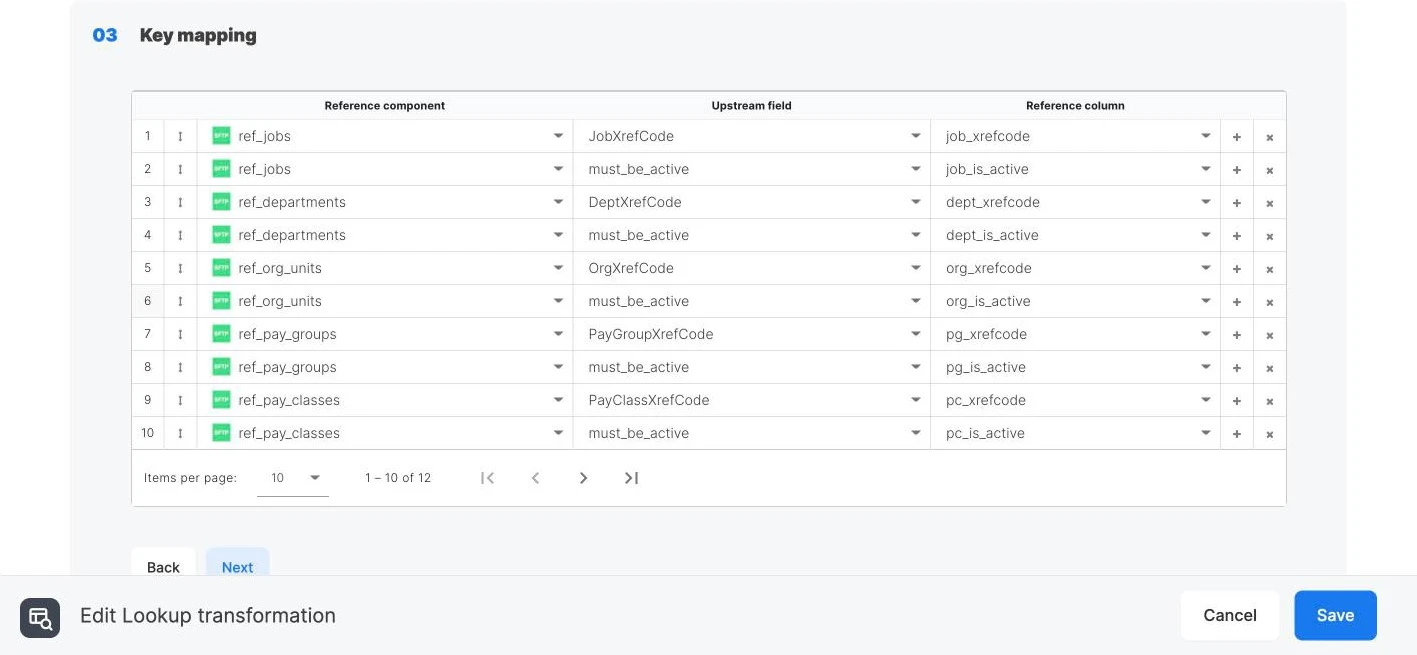

Save the mappings, rules, and lookups as a template. Clone it for the next Workday client and change only what differs.

Map legacy values to Workday reference IDs for organizations, job profiles, locations, and cost centers, and flag any with no match.

Catch missing IDs, duplicates, bad dates, and out-of-range pay. Every rejected row lands in a report with the reason.

Write Data Gathering Workbooks or EIB spreadsheets in the column layout of your existing templates, ready for each tenant build.
Analysts, operators, and engineers can build the pipelines they need, while IT keeps access, standards, and visibility in place.
Predictable pricing for growing data work, without tying budget to every row, sync, connector, or client.
However a pipeline is built, it runs with the same role-based access and audit trail, so IT can see who changed what.
A dedicated Solution Engineer guides implementation and production work alongside 24/7 support.
Use Integrate.io as the end-to-end data pipeline platform for data management, or plug its modular components into the stack your team already prefers.
“The Integrate.io Platform is a great ETL & Data Transformation Solution! Connecting Salesforce, Hubspot, Google Analytics, Facebook Ads, etc... has never been easier.”

Meir Gold
Growth | Analytics Manager
“Awesome ELT Tool. No code tool, easy to set up/use, nice schedules, price balance!”

Diego Polo
Business Intelligence Architect
“Best Customer Service Ever! They have been the best customer service team I have ever worked with from an outside vendor. Always very responsive, and go above and beyond to resolve issues or instruct on the product.”

Matthew Pratt
Analytics Manager
Managed sources and destinations, a universal API connector for custom systems, and new connectors built on demand within 24 to 48 hours.
Book a demo and we'll run a sample client export through to a Workday EIB spreadsheet.
Book a DemoFAQ
Clear answers to the questions teams ask when evaluating Integrate.io.
Still have questions?
Book a Demo →The Enterprise Interface Builder (EIB) is Workday's tool for loading data from a spreadsheet or file. Integrate.io writes the EIB spreadsheet with clean, validated data so the load succeeds.
No. The pipeline writes to the column layout of the workbooks and EIB templates you already use.
Yes. Pipelines look up each legacy value against a Workday reference export and flag anything without a match before the load.
It shortens the data work. Converting each tenant build goes from weeks of spreadsheet fixes to a pipeline run. Configuration, testing, and client sign-off still take the time they take.
Yes. Clone the conversion for each new Workday client and change only the mappings and reference IDs that differ.
We use essential cookies to run this website. With your consent, we also use cookies for analytics, advertising, social media and features like chat. You can change your choice at any time in Cookie Preferences. Read our Cookie Policy