

- TL;DR: SQL vs NoSQL at a Glance
- Introduction
- Comparison of SQL vs NoSQL
- 1. Database Architecture
- 2. Database Schemas and Query Languages
- 3. Database Scaling
- 4. Data Structure
- 5. Use Cases
- Types of NoSQL Databases
- SQL vs NoSQL: Decision Checklist
- SQL Database Systems
- NoSQL Database Systems
- How Integrate.io Helps With SQL/NoSQL Database Integration
- FAQ: Understanding SQL vs NoSQL Databases
When choosing a modern database, one of the biggest decisions is picking a relational (SQL) or non-relational (NoSQL) data structure. Both systems offer unique advantages and cater to different needs, making the choice between them crucial for optimal data management.
SQL (Structured Query Language) is a programming language with a traditional approach that allows relational databases to manage structured data like rows and tables using predefined schemas. NoSQL ("Not Only SQL") offers a more flexible, non-relational approach, ideal for handling unstructured or dynamic data. As businesses evolve and data becomes increasingly diverse, understanding the core differences between SQL and NoSQL is essential.
Key Takeaways
- SQL databases are relational; NoSQL databases are non-relational.
- SQL uses a fixed, predefined schema; NoSQL uses dynamic schemas for unstructured data.
- SQL databases scale vertically (more powerful hardware); NoSQL scales horizontally (more servers).
- SQL databases are table-based; NoSQL databases are document, key-value, graph, or wide-column stores.
- SQL is better for multi-row transactions and complex queries; NoSQL is better for unstructured data, high-volume workloads, and rapid schema changes.
- Many modern architectures use both, SQL for transactional integrity, NoSQL for scale and flexibility.
TL;DR: SQL vs NoSQL at a Glance
| Dimension | SQL | NoSQL |
|---|---|---|
| Architecture | Relational (tables, rows, columns) | Non-relational (documents, key-value, graph, wide-column) |
| Schema | Fixed, predefined | Flexible, dynamic |
| Scaling | Vertical (more powerful hardware) | Horizontal (more servers) |
| Best for | Structured data, complex queries, transactions | Unstructured/semi-structured data, high-volume, rapid change |
| Examples | MySQL, PostgreSQL, Oracle, SQL Server | MongoDB, Cassandra, Redis, DynamoDB |
SQL databases enforce structure and consistency, making them the right choice when data relationships are well-defined and ACID compliance is required. NoSQL databases trade rigid structure for flexibility and horizontal scalability, making them better suited for large-scale, rapidly evolving, or unstructured data workloads. Most production architectures today use both.
Introduction
What is SQL?
SQL is a domain-specific language used to query and manage data. It works by allowing users to query, insert, delete, and update records in relational databases. SQL also allows for complex logic to be applied through the use of transactions and embedded procedures such as stored functions or views.
What is NoSQL?
NoSQL stands for "Not Only SQL." It is a type of database that uses non-relational data structures, such as documents, graph databases, and key-value stores to store and retrieve data. NoSQL systems are designed to be more flexible than traditional relational databases and can scale up or down easily to accommodate changes in usage or load.
Comparison of SQL vs NoSQL
With a basic understanding of what SQL vs NoSQL is, here is a quick comparison chart showing what sets the two apart:
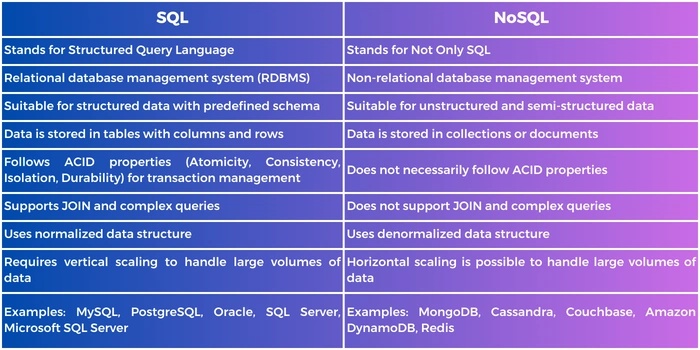
Now that you understand the fundamentals, here are the five key differences between SQL and NoSQL databases that can help you decide which technology best suits your data storage needs.
1. Database Architecture
At the most basic level, the biggest difference between these two technologies is that SQL databases are relational, while NoSQL databases are non-relational.
What Are Relational Databases?
Relational databases (also called relational database management systems, or RDBMSs) use Structured Query Language (SQL) to store and retrieve data. They organize data in rows and tables, connecting information across tables using keys: primary keys identify individual rows, and foreign keys create relationships between tables.
What Is Structured Data?
Structured data is data organized in a consistent, predefined format. Think financial transactions, customer records, or inventory tables. It maps cleanly to rows and columns in a relational database. SQL databases are built specifically to store, query, and manage structured data.
What Are Non-Relational Databases (NoSQL)?
Non-relational databases store data without requiring the rigid row-and-table structure of SQL. Instead, they use a storage model based on the type of data being stored: documents, key-value pairs, graphs, or wide columns.
What Is Unstructured Data?
Unstructured data lacks a predefined format or consistent organization. Examples include images, video files, audio recordings, social media posts, and sensor data. It cannot be stored in a fixed-schema SQL table without significant transformation. NoSQL databases are designed to ingest unstructured data in its native format.
Read more: Which Modern Database is Right for Your Use Case?
2. Database Schemas and Query Languages
SQL databases use structured query language and have a pre-defined schema for defining and manipulating data. SQL is one of the most versatile and widely used query languages available, making it a safe choice for many use cases. It handles complex queries well. However, SQL can be restrictive: you have to use predefined schemas to determine your data structure before you can work with it. All data must follow the same structure, and changing that structure later is difficult and disruptive.
NoSQL databases have dynamic schemas for unstructured data and store data in many ways. You can use column-oriented, document-oriented, graph-based, or key-value stores. This flexibility means:
- You can create documents without having to first define their structure.
- Each document can have its own unique structure.
- The syntax can vary from database to database.
- You can add fields as you go.
What Is ACID Compliance?
ACID stands for Atomicity, Consistency, Isolation, and Durability. It is a set of properties that guarantee database transactions are processed reliably, even in the event of errors or system failures. SQL databases are built with ACID compliance as a core design principle, which is why they are the default choice for financial systems, healthcare records, and any workload where data integrity cannot be compromised.
Some NoSQL databases, including MongoDB (as of version 4.0), now support ACID compliance at the transaction level. However, most NoSQL systems prioritize availability and partition tolerance over strict consistency, following the CAP theorem tradeoff. If your application requires guaranteed transactional integrity across multiple records, SQL remains the safer default.
Read more: Complete Guide to Database Schema Design
3. Database Scaling
Another difference between SQL vs NoSQL databases is scaling. SQL databases are vertically scalable in most situations. That means you can increase the load on a single server by adding more CPU, RAM, or SSD capacity.
How NoSQL databases work is fundamentally different: they are horizontally scalable. You can handle higher traffic via a process called sharding, which distributes data across multiple servers. Horizontal scaling has a greater overall capacity ceiling than vertical scaling, making NoSQL databases the preferred choice for large and frequently changing data sets.
Vertical vs horizontal scaling, illustrated:
SQL (Vertical Scaling) NoSQL (Horizontal Scaling)
 [Server] [Server] [Server] [Server]
 | | | |
 Add CPU/RAM Add more servers as needed
 (limited by hardware) (scales to any volume)
For example, a media streaming platform storing millions of video files would use a NoSQL database because the data volume and object size would quickly exceed what a single vertically scaled SQL server can handle.
4. Data Structure
SQL databases are table-based, where each field in a data record maps to a named column. This proves beneficial when performing multiple data transformations or running complex joins across related tables.
NoSQL databases are document, key-value, graph, or wide-column stores. These flexible data models make NoSQL databases easier to use for applications where data shape varies across records.
5. Use Cases
SQL databases are better for multi-row transactions, while NoSQL is better for unstructured data like documents or JSON. SQL databases are also commonly used for legacy systems built around a relational structure.
SQL Use Cases
- Financial and transactional systems: banking platforms, point-of-sale systems, and accounting software require ACID compliance to ensure no transaction is partially applied.
- ERP systems: HR databases, supply chain management, and inventory systems rely on well-defined relationships between entities.
- Regulatory compliance scenarios: any workload subject to GDPR, HIPAA, or SOX auditing benefits from the auditability and consistency guarantees of SQL.
- User-oriented applications with join operations: SQL schema helps establish ACID properties and improves data compatibility across related tables.
Some examples of SQL databases include MySQL, Oracle, PostgreSQL, and Microsoft SQL Server.
NoSQL Use Cases
- IoT platforms: real-time sensor data from smart home systems, traffic management networks, and industrial equipment generates high-volume, schema-free streams that NoSQL handles natively.
- Digital asset management: media streaming platforms and photo-sharing applications store large binary objects (images, video, audio) that don't fit a relational table structure.
- Social networks and fraud detection: graph databases like Neo4j model relationships between entities (users, accounts, transactions) and can traverse millions of connections to detect anomalies in milliseconds.
- Healthcare records with unstructured files: a hospital system storing patient notes, X-rays, and scan images alongside structured demographic data benefits from NoSQL's ability to handle mixed data types.
- Applications with dynamic data: NoSQL is better suited for workloads where data structures evolve rapidly and missing fields won't break the application.
NoSQL database examples include MongoDB, BigTable, Redis, Cassandra, HBase, Neo4j, and CouchDB.
Hybrid Approaches
Many modern production architectures use both SQL and NoSQL databases in the same stack. A common pattern: use a SQL database (PostgreSQL, MySQL) for transactional data that requires ACID compliance, and a NoSQL database (MongoDB, Redis, Cassandra) for high-volume, flexible, or unstructured data. For example, an e-commerce platform might store order transactions in PostgreSQL and product catalog data with variable attributes in MongoDB. Choosing one does not mean excluding the other.
Read more: Data Warehouse vs. Database: 7 Key Differences
Types of NoSQL Databases
Not all NoSQL databases work the same way. There are four main types, each optimized for a different data model and query pattern.
Document Databases
Document databases store data as JSON-like documents. Each document can have a unique structure, with nested fields and arrays, making them highly flexible. They are well-suited for content management systems, user profiles, and product catalogs where each record may have different attributes.
Example: MongoDB. A product catalog where each product has a different set of specifications (a laptop has RAM and CPU; a t-shirt has size and color) is a natural fit for a document database.
Key-Value Stores
Key-value stores save data as unique key plus associated value pairs. They are optimized for extremely fast lookups and are the simplest NoSQL data model. They work well for session management, caching, and real-time leaderboards.
Examples: Redis, DynamoDB. A web application caching user session tokens for fast authentication is a classic key-value use case.
Column-Family Stores (Wide-Column)
Wide-column databases organize data by columns rather than rows. They are optimized for large, sparse datasets where most rows have only a few populated columns. They excel at time-series data, analytics workloads, and write-heavy applications.
Examples: Apache Cassandra, HBase. A telemetry platform ingesting billions of IoT sensor readings per day, where each reading has a timestamp and a handful of metric values, is a strong wide-column use case.
Graph Databases
Graph databases store data as nodes (entities) and edges (relationships). They are optimized for relationship-heavy queries that would require expensive multi-table joins in SQL. They are the go-to choice for social networks, recommendation engines, and fraud detection.
Examples: Neo4j, Amazon Neptune. A fraud detection system that needs to identify whether two bank accounts share a device, phone number, or IP address across millions of records can traverse those relationships in milliseconds with a graph database.
SQL vs NoSQL: Decision Checklist
Use this framework to decide which database type fits your workload.
Use SQL when:
- Your data is structured and relationships between tables are well-defined.
- You need ACID compliance (financial, healthcare, or legal data).
- Your application requires complex multi-table joins and queries.
- Your data schema is unlikely to change frequently.
- You are working with a legacy system built around a relational structure.
Use NoSQL when:
- Your data is unstructured, semi-structured, or rapidly evolving.
- You need horizontal scalability for high-volume or unpredictable traffic.
- Your application handles large objects (images, video, sensor streams).
- Development speed matters more than schema rigidity.
- Your data model varies significantly from record to record.
Use both when:
- You have distinct transactional and analytical workloads in the same application.
- One part of your system requires strict consistency; another requires scale and flexibility.
- You are building a modern data stack that separates operational data from analytical data.
SQL Database Systems
Here are some of the most popular SQL database systems:
MySQL
- Free and open-source
- An extremely established database with a large community, extensive testing, and strong stability
- Supports all major platforms
- Replication and sharding are available
- Covers a wide range of use cases
Oracle
- Commercial database with frequent updates, professional management, and excellent customer support
- Uses PL/SQL (Procedural Language/SQL) as its SQL dialect
- One of the more expensive database solutions on the market
- Designed for very large databases and demanding enterprise workloads
- Simple upgrades and transaction control
- Compatible with all major operating systems
Microsoft SQL Server
- A commercial database developed and managed by Microsoft
- Uses T-SQL (Transact-SQL) as its SQL dialect
- Works with Windows and Linux
- User-friendly with excellent documentation
- Works well for small-to-medium-sized organizations that want a commercial database solution without the cost of Oracle
PostgreSQL
- Object-relational database management system, making it a hybrid SQL/NoSQL database solution
- Free and open-source
- Compatible with a wide range of operating systems
- Active community and many third-party service providers
- High ACID compliance and uses pure SQL
- Works best for use cases where data doesn't support a strictly relational model, extra-large databases, and complex query workloads
NoSQL Database Systems
Here are some of the most widely used NoSQL database systems:
MongoDB
- The most widely adopted NoSQL database
- Free to use with a dynamic schema
- Horizontally scalable with excellent performance on simple queries
- Add new columns and fields without impacting existing rows or application performance
- Supports ACID transactions at the document and multi-document level (as of version 4.0)
- Works best for companies going through rapid growth or those with large volumes of unstructured data
- Lesser-known alternatives include Apache Cassandra, Google Cloud BigTable, and Apache HBase
Cassandra
- Handles large amounts of data across commodity servers
- High availability with no single point of failure
- Follows peer-to-peer architecture
- Horizontally scalable and open-source
- Optimized for write-heavy workloads and time-series data
How Integrate.io Helps With SQL/NoSQL Database Integration
Once you have decided on SQL or NoSQL databases, you need to move data into them. Data integration is a complex process that can present serious challenges. Done wrong, you risk losing valuable data or facing fines for non-compliance with frameworks like GDPR, HIPAA, and CCPA.
Integrate.io is a low-code data pipeline platform that moves data from siloed sources into your database of choice without requiring extensive programming or dedicated data engineering resources. The platform is SOC 2 certified and GDPR, HIPAA, and CCPA compliant, so your pipelines meet regulatory requirements from day one.
For SQL and NoSQL integration specifically:
- The native MongoDB connector extracts data from a source, transforms it using any of 220+ built-in transformations, and loads it into MongoDB without building pipelines from scratch. You can also ETL MongoDB data to a data warehouse for analytics.
- Connectors for MySQL, PostgreSQL, Oracle, and Microsoft SQL Server are all available out of the box.
- A dedicated Solution Engineer supports your team throughout onboarding and beyond, think of them as an extension of your data team, not a ticketing queue.
Schedule a demo to see how Integrate.io handles SQL and NoSQL integration for your specific workload.
FAQ: Understanding SQL vs NoSQL Databases
1. What is the main difference between SQL and NoSQL databases?
SQL databases are relational, using structured query language to manage structured data with a predefined schema in tables. NoSQL databases are non-relational, offering a flexible approach for handling unstructured or dynamic data without a fixed schema, often in formats like documents, key-value pairs, or graphs.
2. Why would someone prefer using a NoSQL database over an SQL database?
NoSQL databases are preferred for their flexibility and scalability, especially for applications with large, unstructured data sets or rapidly changing data structures. They allow for faster data storage and access without a predefined schema, which speeds up development cycles and reduces upfront data modeling work.
3. Can SQL databases handle the same types of data as NoSQL databases?
SQL databases are highly effective for structured data and complex transactional queries. They are not as flexible as NoSQL databases when dealing with unstructured or semi-structured data because their fixed schema requires all data to conform to a predefined structure before it can be stored.
4. How do SQL and NoSQL databases scale differently?
SQL databases scale vertically, meaning they require more powerful hardware to handle increased loads. NoSQL databases scale horizontally, distributing data across multiple servers to manage larger volumes of traffic or data. Horizontal scaling has a higher capacity ceiling, making NoSQL better suited for web-scale applications.
5. What is ACID compliance and why does it matter for SQL databases?
ACID stands for Atomicity, Consistency, Isolation, and Durability. These properties guarantee that database transactions are processed reliably, even if errors or system failures occur. SQL databases are built with ACID compliance as a core feature, which is why they are the standard choice for financial systems, healthcare records, and any workload where partial or inconsistent writes are unacceptable.
6. Can NoSQL databases be ACID-compliant?
Some NoSQL databases now support ACID compliance at the transaction level. MongoDB added multi-document ACID transactions in version 4.0. However, most NoSQL systems are designed to prioritize availability and partition tolerance over strict consistency, so ACID support varies significantly by database and configuration.
7. What is sharding in NoSQL databases?
Sharding is the process of distributing data across multiple servers (shards) so that no single server holds all the data. It is the primary mechanism behind horizontal scaling in NoSQL databases. Each shard holds a subset of the total data, and queries are routed to the appropriate shard. Sharding allows NoSQL databases to handle data volumes and traffic levels that would overwhelm a single vertically scaled server.
8. What is the difference between a document database and a key-value store?
A document database stores data as structured documents (typically JSON or BSON), where each document can contain nested fields and arrays. A key-value store is simpler: it stores a unique key paired with a value, with no internal structure required. Document databases are better for complex, queryable data; key-value stores are better for fast, simple lookups like caching or session management.
9. Is PostgreSQL SQL or NoSQL?
PostgreSQL is primarily a SQL (relational) database. However, it supports JSON and JSONB data types, which allow it to store and query document-style data. This makes it a hybrid option that can handle some NoSQL-style workloads without giving up relational features or ACID compliance.
10. When should I use both SQL and NoSQL in the same application?
Use both when your application has distinct workloads with different requirements. A common pattern is to use SQL for transactional data (orders, payments, user accounts) where ACID compliance matters, and NoSQL for high-volume or flexible data (product catalogs, session data, media files) where scalability and schema flexibility matter more. Many modern data stacks are built this way.
11. What are some examples of SQL and NoSQL database systems?
SQL database examples include MySQL, PostgreSQL, Oracle, and Microsoft SQL Server, known for robust transactional support and complex query capabilities. NoSQL examples include MongoDB, Cassandra, Redis, and Amazon DynamoDB, favored for scalability and flexibility with unstructured data.